
Love that Devours
A short musing on vampire romance and ancient myths

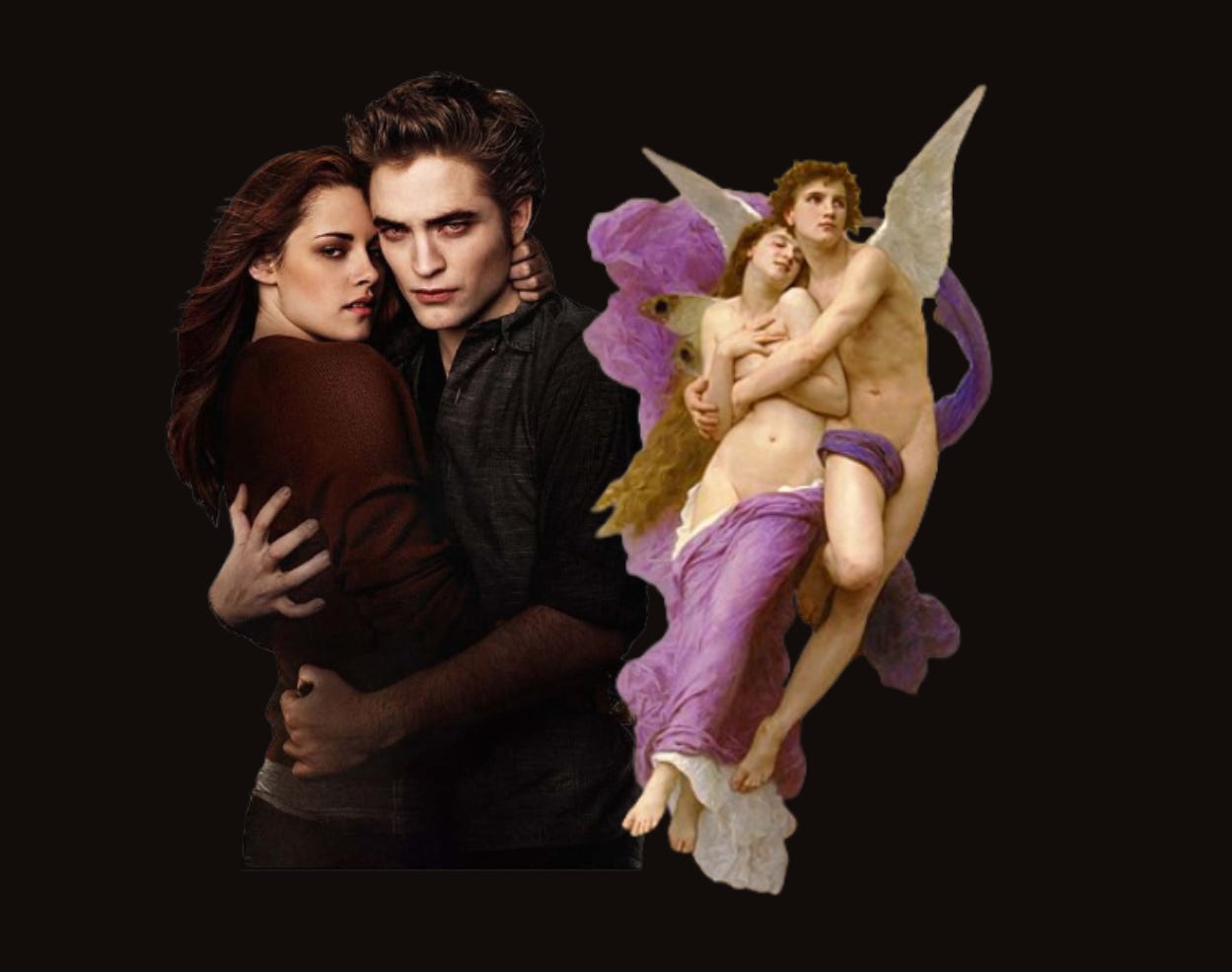
Earlier this summer after countless debates on the matter, spiritual torment of principals, ethics, and everything humanity holds to be good and beautiful in this world I committed myself to read Stephenie Meyer’s Twilight. After engaging in many conversations concerning the book (usually ending with “well you haven’t actually read it, have you?”) I was determined to advance into further engagements with True Knowledge.
The journey into the young adult fiction section of the library was nearly as horrifying as the prospect of reading the 500 pages of vampire love triangles. After braving the shadowy recesses in the back of the library and lurking characters therein, the book was secured and a hasty exit made.
All jesting aside, I got more than I reckoned for.
It just so happened that at the same time I happened to be reading C.S.Lewis’ Till We Have Faces. At first I thought nothing of the pairing. After all, what could a teen romance about werewolves and estranged vegetarian vampires have anything to do with such a book? It was when I got to the line in Faces that has stuck with me longer than nearly any other line in literature that I sat up. The priest in the retelling of Cupid and Pysche, while describing the great sacrifice to the god of the mountain proclaims:
“In the Great Offering, the victim must be perfect. For, in holy language, a man so offered is said to be Ungit’s husband, and a woman is said to be the bride of Ungit’s son. And both are called the Brute’s Supper… Either way there is a devouring. Some say the loving and the devouring are all the same thing.”
- Till We Have Faces, Chapter V
I returned to Edward and Bella with a strange fascination.
“About three things I was absolutely positive. First, Edward was a vampire. Second, there was a part of him-and I didn’t know how potent that part might be-that thirsted for my blood. And third, I was unconditionally and irrevocably in love with him.”
- Stephenie Meyer, Twilight
The stories seemed similar. In both, a mortal woman falls in love with a supernatural god-like bridegroom who, despite being omnipotent and dangerous accepts her as his wife. There is a parallel of loving…and devouring. What is the connection then? Are the loving and devouring the same across the books?
The key appeared with the vampire.
The vampire appears across all legends and mythology as an image of eternal death. He subsists on the life of others for his life, a parasitical parody of sacrificial love. It is a small wonder that Milton in his Paradise Lost uses vampiric imagery to describe Satan as he creeps into the Garden of Eden to tempt Eve. Satan himself, a parody of an eternal sacrificial God, is such an immortal dead and he is determined to make mankind such as well. It is thus that in the genesis story Adam and Eve are cast out of the garden with the words of God echoing:
“Behold, the man has become like one of us, to know good and evil: and now, lest he put forth his hand, and take also of the tree of life, and eat, and live forever…”
- Genesis 3:22
If mankind were to eat of the tree of life in such a fallen state we too, would be transformed into the immortal dead. The salvation plan required man to die to be born again, something that would prove impossible if death became eternity.
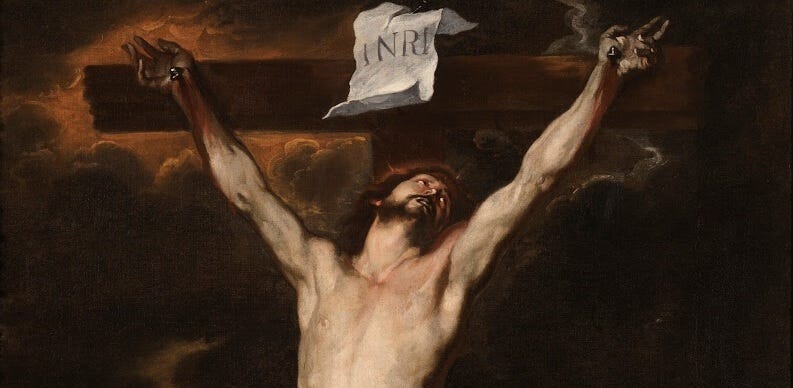
Along with the image of living in death, vampires are also associated with, most famously, the drinking of blood. This too, is tied into the tree of life. The command of the garden (“do not eat of this tree”) becomes the new command of Christ’s sacrifice on the cross (“come and eat of this tree”). Thus, vampires embody a sort of anti-eucharist image. From the dementor’s kiss (parody of the kiss of life, think sleeping beauty) to the evil stepmother in fairy tales hungering after innocent children (Lilith and every wicked witch ever) the vampire is not concerned with giving life with their own body but taking it with their own body.
The whole beauty of the story of salvation is the incredible reversal of the imagery. No longer will the bride be devoured by the vampire of sin, the eternal dead. Instead Christ presents himself in sacrifice as the one to be devoured for his bride to have eternal life. This is also the story of Till We Have Faces, the story of Cupid and Pysche. Pysche (greek for the word “soul”) is the bride of what first appears to indeed be a devouring monster but turns out to be the god of love. When the curse of death falls upon the couple after disobedience, it is the bridegroom, the god, that gives of himself to save Pysche, his beloved. It is the lover letting himself be devoured for his lover.
Twilight turned out to be a strange parody of this. Though the love and devouring are also spoken of similarly, in reality there is only devouring. Bella and Edward’s love does not transcend to the sacrifice of self for another as nourishment. It is the very opposite sort of love that is also spoken of in Faces. Orual’s so called “love of Pysche” is the kind that does not give as nourishment but feeds to fulfill itself and its own desires. Although Edward acknowledges to Bella that living as a vampire is a horrible thing, she would rather join him in eternal death and devouring then give up what she wants. And he consents to transform her and drink her blood. It is a constant cycle of preying and pining. Bella pleads and even though it harms her, Edward consents for sensual effect.
Is this perhaps reading too deeply into what is very much a sub-par teenage romance with little to none symbolic value? Perhaps. However, Twilight strikes a chord deeper, a chord that echoes throughout every age of humanity, vampires or not. Across every human heart is the profound desire to be loved by the supernatural. The Christian mystic tradition holds this at its core: the soul is singing a song to its beloved, trying to get back to perfect union with Him. John of the Cross, one of my favorite mystics penned hundreds of verses about this mysterious yearning.
“Where have You hidden Yourself, And abandoned me in my groaning, O my Beloved? You have fled like the hart, Having wounded me. I ran after You, crying; but You were gone. My soul is occupied, And all my substance in His service; Now I guard no flock, Nor have I any other employment: My sole occupation is love.”
- John of the Cross, Spiritual Canticles
Each soul has the Bridegroom waiting and calling out for it, although He be hidden, and try as one might such a cosmic call cannot ever be silenced. It is the call of the Great Lover who offers Himself to be devoured by his beloved so that she might possess eternal life, not eternal death.
“Do you think it all meant nothing, all the longing? The longing for home? For indeed it now feels not like going, but like going back. All my life the god of the mountain has been wooing me. Oh, look up once at least before the end and wish me joy. I am going to my lover.”
- Till We Have Faces, Chapter
And that is something Edward Cullen, as sparkly as he is, cannot ever profess. The mystery of bridegroom letting Himself be devoured so that His beloved may live.
This is a fascinating take. Thank you for writing and sharing.
Fantastic article!